Advancing Black homeownership in Richmond

Mary Kay Huss, Richmond Metropolitan Habitat chief executive officer, talks about historic housing discrimination and what Habitat is doing to help advance Black homeownership locally.

For Black Americans, the barriers to homeownership created by historic discrimination in the U.S. housing market still persist today. From redlining neighborhoods, a practice where Black families were denied home loans based on color-coded maps developed by the federal Home Owners’ Loan Corporation in the 1930s, to racially restrictive covenants stipulating that homes were only sold or resold to white families, the list of housing discriminations meant to deny Black individuals the opportunity to build a better life has had far-reaching consequences across wealth, health, education and employment.

Mary Kay Huss, chief executive officer of Richmond Metropolitan Habitat for Humanity, has worked in the affordable housing sector for nearly 30 years. “We can’t change the past,” she says. “But what we can do is do the next right thing every time, and that is providing homeownership opportunities.”

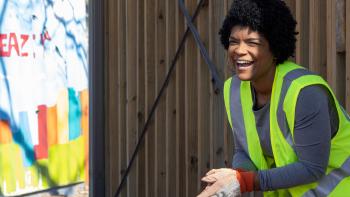
Mary Kay Huss portrait

Mary Kay Huss, chief executive officer of Richmond Metropolitan Habitat for Humanity

Mary Kay sheds light on the history of housing inequity in Richmond, Virginia, and shares how Richmond Habitat brings people together to create equitable housing opportunities for all.

What are some of the barriers that have prevented Black residents in Richmond from becoming homeowners?

The decision to build two highways through Richmond bisected once-thriving communities of color and isolated them. Public housing communities in Richmond were built and cordoned off by these highways, concentrating poverty in these areas and really making it difficult for those residents to access homeownership and other services. Redlining took place, and decades of this systemic racism created the racial disparity that we see in homeownership today.

How do these barriers to homeownership continue to affect Black residents who want to become homeowners in Richmond today?

Real estate taxes and the values of homes are going up. However, some of the lower-value homes in non-white neighborhoods are a prime example of racial bias in real estate valuations. Some of those older, non-white neighborhoods have lower values. So even if Black residents are able to own homes in these areas, they’re not able to add to their equity and subsequently add to their generational wealth as quickly or as much as they could if they were living in another neighborhood. Our city council has budgeted for our fair housing organization to examine the fairness of those property values and see if they’ve been kept artificially depressed, even as real estate values have soared in other parts of the city.

What is the reality of the homeownership gap in your area?

Black homeownership is at its lowest level. Only 48% of Black households in Virginia own their homes, as compared to 73% of white households.

What has Richmond Habitat done to prioritize Black homeownership?

This year, Richmond Habitat worked on a constitutional amendment for tax relief for long-term residents. It’s aimed at allowing an expansion of the tax relief program currently in place in the city to apply to long-term residents so that we can keep them in gentrifying neighborhoods. In the state of Virginia, that bill has to go to the General Assembly and has to be enacted to a constitutional amendment. It has to be presented two years in a row. Along with our partner, the Virginia Housing Alliance, we talked to our legislators who were willing to patron that bill. It was presented this first year, and we will do it again next year.

Also, working with our local housing authority, we were able to obtain over 30 vacant properties that were located in a desirable part of the city close to the river. We call that neighborhood the Maymont-Randolph neighborhood, and over the past three years we’ve been systematically working on those vacant properties, some of which were homes that had been moved in order to make room for highways. They were once boarded up and really a blight in that community. And we, along with another nonprofit who also got 37 properties, really were able to change the demographics of an entire block and bring in new homeowners, including Habitat homeowners that were making anywhere between 30 and 60% of the area median income.

Why is advancing Black homeownership a priority for Richmond Habitat?

It’s what we’ve always done, but George Floyd and the racial reckoning that happened around that time really impacted the city of Richmond. We’re known as the capital of the Confederacy, and there was a lot of public outcry about Confederate monuments over the past two years. That all brought the inequities to the forefront.

Providing equitable homeownership opportunities to those who didn’t have a level playing field is, again, something we’ve always done, but we hadn’t really talked about it that way. We changed our narrative to talk about advancing Black homeownership in a way that was very relevant to Richmond. I started emphasizing equitable access to homeownership for Black homeowners and people of color, and in the audiences I would see heads start nodding.

The more we more we learn about it, the more we understand that we have to keep doing this, and we have to do it in a bigger way. We have to do more of it because there have been inequities for decades. I don’t know that we can ever turn it around or solve it —but we can keep doing this work because it’s important and it’s necessary.

Advancing Black Homeownership

Habitat for Humanity’s vision is a world where everyone has a decent place to live, but a structure of intentional and systemic racial discrimination in the U.S. has created barriers to homeownership for many Black families.

Learn more
Off
Habitat house in Rochmond with bright blue door

Advancing Black homeownership in Richmond

Teaser image
Habitat house in Richmond

Closing the racial homeownership gap in the U.S.

As part of our +You thought leadership series, a group of experts gathered for a livestream event to explore the deep-seated inequities in America’s housing market – and the steps necessary to create more inclusive housing practices.

Advancing Black Homeownership

Habitat for Humanity’s vision is a world where everyone has a decent place to live, but a structure of intentional and systemic racial discrimination in the U.S. has created barriers to homeownership for many Black families.

Capacity statements

See our global capacity overview or read Habitat’s country level capacity statements, which include specific areas of programming and expertise. 

The value of volunteering

Research has shown that volunteering is associated with improved health and well-being, including increased longevity, adoption of healthy lifestyles and reduction in depression and stress. Dive into the research around these benefits in our evidence brief.

Volunteer

Habitat for Humanity, like many other nonprofit organizations, relies on volunteers to achieve its mission. Volunteers play key roles across the scope of nonprofit work, from working in offices to supporting programming in communities.

Volunteering can also take many different forms, from long-term volunteering to virtual volunteering and more.

The value that volunteering brings to the organizations served is well-known, but the impact of volunteering doesn’t stop there. Although many people are motivated by a sense of altruism, the volunteers themselves walk away with benefits.

Research has shown that volunteering is associated with improved health and well-being, including increased longevity, adoption of healthy lifestyles and reduction in depression and stress. The service volunteers provide also goes on to benefit the communities in which they live and serve.

Dive into the research around the value and benefits of volunteering in our evidence brief.

This evidence brief:

  • Explores behaviors and trends in volunteers and types of volunteering.
  • Features the benefits of volunteering to individuals.
  • Illustrates how volunteering benefits local communities.
  • Highlights how volunteers help Habitat.

5 creative ways to volunteer with Habitat

“You don’t have to swing a hammer,” one Habitat volunteer says. It takes a lot of people performing a variety of tasks to help families find decent shelter. Consider adding one of these creative efforts to your to-do list.

Read more

Volunteer

Volunteer with Habitat in your community and around the world. With our help, families can achieve the strength, stability and independence they need to build a better life.

Read more
Basic
Off
A young woman in a blue shirt laying flooring.

The value of volunteering

Research on the benefits of service for volunteers

Teaser image
Home is the Key build day with O-Cedar and At Home.

AmeriCorps member finds joy in giving back

Ryan helped his family build their own Habitat home. Now, as an AmeriCorps member, he’s helping others realize their dream of homeownership.

Ryan has come full circle. As a teen, he helped his family build their own Habitat for Humanity home. Now, the 23-year-old AmeriCorps member serves with Habitat for Humanity of East Jefferson County as a construction volunteer lead. “When I came back from college, I thought, ‘Wow, this community has been so good to me. Not just the Habitat community, but the community in general. This is a way I can give back,’” he says.

As construction volunteer lead, Ryan welcomes volunteers to the build site, ensures they have proper safety equipment and acts as a contact for questions. He also builds, assisting with activities like painting and lifting trusses. “Every day is different,” says Ryan, who has helped families and volunteers build six homes since the beginning of his service term.

Ryan in a hardhat working on a roof.

The experience of working on a team has helped the recent college graduate grow professionally. “I hadn’t had a lot of experience working in the field with other teammates,” he says. “This has really helped me to hone my leadership and management skills.”

Whenever he has the opportunity, Ryan is happy to share his own story with future homeowners and offer words of encouragement as they build. “I think it helps our connection, my being able to say I’ve been through the whole process before and my family built a house, they still live there, and it’s given us these opportunities now and in the future,” he says.  

A strong foundation

Before their Habitat home, Ryan’s family moved often. The family lived overseas for a period of time doing missionary work and were unable to find affordable housing upon their return.

Washington state’s Olympic Peninsula, which includes East Jefferson County, is known for its scenic coastal areas, forests and mountains. The area’s housing market is highly competitive and expensive. That’s why Ryan’s family decided to apply to Habitat. “Even renting is really difficult here because many houses that are available are snatched up within a week, or even a few days, because the demand is so great,” Ryan says.

Ryan sanding a door frame

Having a stable home has helped Ryan and his three siblings thrive. “It helped me psychologically to think it’s OK to relax and make friends and be open to people,” he says. Ryan’s parents also were able to develop deeper roots in the community. His father is a pastor at a local church, and his mother works as a high school administrator.

A call to service

It was Ryan’s father who first learned about the AmeriCorps role and shared it with his son. As a pastor, he’d given blessings at Habitat house dedications ever since his own family built their home. When he learned about Habitat’s AmeriCorps program and the open position, he thought Ryan might be the perfect fit. “It only took me about a day to consider it, and I thought ‘Hey, this is just what I want to do,’” Ryan says.

Ryan getting ready to paint

His family’s history with Habitat and his heart for service has helped Ryan flourish as a construction volunteer lead. “The way he interacts with the homeowners, it’s just with this extra level of understanding and kindness,” says Amy Howard, Habitat East Jefferson County’s volunteer outreach and advocacy manager.

As he plans his next steps, Ryan hopes to incorporate service into whatever career path he chooses. “To have my occupation affect others in a positive way is really meaningful,” he says.

Basic
Off
Ryan standing on a build site.

AmeriCorps member finds joy in giving back

Teaser image
Ryan standing on a build site
Subscribe to